
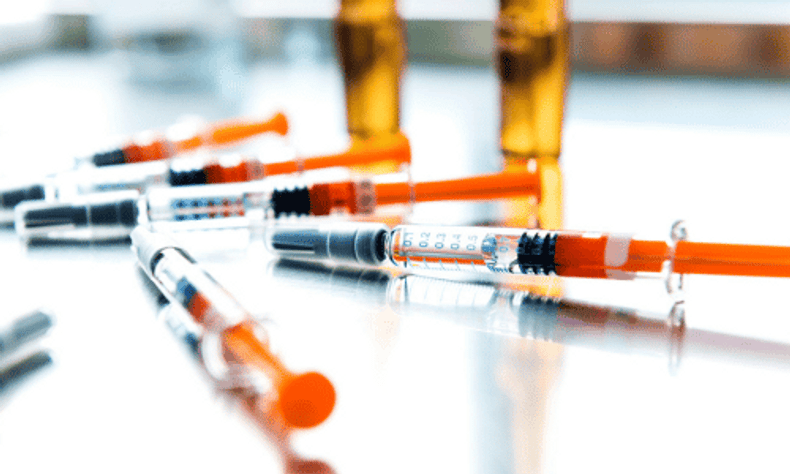
Traveling with syringes overnight comes down to four things: a packed kit with spares, temperature-stable storage for your medication, a private moment to inject, and a hard-sided container to carry used needles home in. None of it requires special equipment — a small insulated pouch, a travel sharps container, and ten minutes of packing the night before will cover almost any one-night stay.
What throws people off is rarely the injection itself. It’s the unfamiliar bathroom counter, the hotel mini-fridge that freezes everything on the top shelf, and the moment at 11pm when you realise you have a used needle in your hand and nowhere safe to put it. This guide walks through each of those situations, and finishes with TSA rules and a packing checklist you can reuse.
Key takeaways
- Pack 2–3 more syringes than you think you’ll need, plus a backup dose where your prescription allows.
- Unopened insulin keeps at 36–46°F; in-use vials and pens sit at room temperature for a set number of days that varies by product.
- Never leave a used syringe in hotel trash, an airplane seat pocket, or a public restroom bin.
- The FDA’s two-step rule applies everywhere: sharps container immediately after use, then dispose of the container by local rules.
- TSA allows unlimited unused syringes when they travel with injectable medication, and used syringes in a hard-sided sharps container.
The Short Answer: What One Night Away Actually Requires
For a single night away from home, you need enough syringes for your scheduled doses plus two spares, your medication stored within its labelled temperature range, alcohol prep pads, and a hard-sided container to hold used sharps until you get home. Everything else is comfort.
The two-spare rule exists because of how injections go wrong away from home. A syringe gets dropped on a carpet. A plunger sticks. You draw a dose and the vial is cloudy when it shouldn’t be. At home that’s a minor annoyance because the box is in the cupboard. In someone else’s guest room at midnight, a spare is the difference between keeping your schedule and missing a dose.
Build a Travel Injection Kit That Covers You
A travel injection kit is a single zippered pouch holding every supply needed for a dose, kept packed between trips so nothing is forgotten in a rush. Keeping it permanently assembled — rather than gathering items each time — is the single biggest reduction in travel-related mistakes.
The core supplies
- Syringes, in sealed sterile packaging, counted for your doses plus two spares
- Your medication, in its original labelled packaging
- Alcohol prep pads — pack more than you need; they’re light and they go missing
- A portable sharps container sized for the trip
- Cotton balls or gauze, and small adhesive bandages
- A copy of your prescription or a pharmacy label, in case you’re asked
Backups worth packing
- A second vial or pen if your prescription allows a spare and the trip extends beyond a day
- A small ice pack or gel sleeve for refrigerated medication
- Hand sanitizer, for when you can’t reach a sink before preparing a dose
- A zip-top bag as a last-resort barrier if your sharps container is lost
Keep supplies in their original sterile packaging until the moment of use. Loose syringes rolling around a bag can have their packaging compromised without any visible sign.
A note on prefilling doses in advance
Prefilling syringes before a trip is sometimes recommended by clinicians for specific medications, and sometimes specifically advised against for others, because stability outside the vial varies by drug. This is a question for the prescribing clinician or pharmacist rather than a general travel rule, and the answer depends on the medication, not the trip.
Keeping Medication at the Right Temperature
Most injectable medication tolerates ordinary room temperature, but the margins narrow quickly in a car, a window-facing hotel room, or a cooler packed directly against an ice block.
Insulin and refrigerated medication
Unopened insulin should be refrigerated between 36°F and 46°F (2°C to 8°C) and will stay good until the printed expiration date. Once a vial or pen is in use, it can be kept at room temperature between 59°F and 86°F (15°C to 30°C), and most products are discarded 28 days after first use — though some run shorter and some, like certain long-acting products, run to 42 or 56 days. MedlinePlus’s guidance on insulin and syringe storage covers the general ranges; the exact in-use window is printed on your own product insert, and Wisconsin DHS publishes a product-by-product comparison table that is useful if you carry more than one product.
Two practical consequences for an overnight stay:
- If your vial is already in use and the room stays below 86°F, you do not need a fridge at all for one night. The insulated pouch is for transit through a hot car or airport, not for the nightstand.
- If you do use a hotel mini-fridge, keep the medication away from the back wall and the top shelf, where temperatures often drop below freezing. Insulin that has frozen should not be used, even after it thaws.
Hot cars, cold weather, and direct sun
Avoid leaving supplies in a parked car, in a bag next to a heater or radiator, or in direct sunlight on a windowsill. Guidance for insulin specifically advises discarding it if storage temperature has gone above 98.6°F (37°C). A car interior reaches that on a mild afternoon.
In cold weather, the risk reverses — keep medication in an inside coat pocket or the main compartment of a bag rather than an outer pocket or a checked bag that may travel in an unheated hold.
Injecting in an Unfamiliar Space
The goal in an unfamiliar room is a clean, flat, well-lit surface and uninterrupted hands. Bathrooms are the usual default because they lock and they have a sink, but they are also the least clean surface in most homes and hotels.
Setting up a clean surface
Lay down a clean paper towel, a folded tissue, or the inside of your opened kit as a working surface before you set anything down. Don’t place an uncapped syringe or an opened alcohol pad directly on a counter, a bedspread, or a toilet tank.
Light matters more than people expect. Drawing an accurate dose depends on reading small graduation marks, and hotel bathroom lighting is often dim and overhead, casting a shadow directly onto the barrel in your hand. A phone flashlight propped against a wall solves it.
Hand hygiene without your usual setup
Wash your hands with soap and warm water for at least 20 seconds and dry them completely on a clean towel — not on a shared hand towel that has been hanging in a guest bathroom all week. A paper towel or your own packed cloth is better. Where there’s no usable sink, alcohol-based hand sanitizer rubbed in until completely dry is the fallback.
Then clean the injection site with a fresh alcohol prep pad and let it air dry. Injecting through wet alcohol stings and can carry surface contaminants into the puncture.
Privacy on your own terms
You are not obliged to explain a medical routine to a host, a roommate, or a colleague. A few practical adjustments:
- Carry the kit in a pouch that reads as toiletries rather than medical supplies
- Ask for a few minutes alone rather than explaining why
- If you’re sharing a fridge, a plain opaque container or a labelled bag keeps your medication both findable by you and uninteresting to everyone else
- If you’d rather someone know — a travel partner, a colleague on a work trip — telling one person where your supplies are is a reasonable safety measure, especially if you use insulin
Disposal: The Part Most People Get Wrong
Never leave a used syringe in hotel housekeeping trash, a bathroom bin, an airplane seat pocket, or a bedside wastebasket. Used sharps in general waste are how cleaning staff, housekeepers, and sanitation workers get stuck.
The FDA recommends a two-step process that applies identically at home and on the road: place every used needle and sharp into a sharps disposal container immediately after use, then dispose of the full container according to your community’s guidelines. The agency also advises replacing the container when it is about three-quarters full, because overfilling is itself a common cause of needlestick injury, and never reusing a sharps container. The FDA’s consumer sharps disposal guidance covers both steps in detail.
Why this matters beyond your own trip
The scale of needlestick injury in professional settings gives a sense of how easily it happens even among people trained to handle sharps. The CDC estimates that around 385,000 needlesticks and other sharps injuries are sustained by hospital-based healthcare personnel each year — roughly 1,000 per day, as NIOSH notes in its sharps injury prevention work. A housekeeper emptying a bin has none of that training and no expectation of a needle inside.
Travel-size sharps containers
A travel or pocket-size sharps container is a small, rigid, puncture-resistant container with a closable lid, designed to hold used needles securely in a bag. It is the simplest solution to the entire disposal problem, costs very little, and takes up less room than a deodorant stick. The FDA explicitly recommends carrying one when leaving the house.
Browse portable and standard sharps containers sized for travel through to clinic use.
If you don’t have a sharps container
Where an FDA-cleared container isn’t available, the FDA accepts a household container as a temporary alternative, provided it is:
- Made of heavy-duty plastic that a needle cannot penetrate
- Closable with a tight-fitting, puncture-resistant lid
- Leak-resistant and stable upright while in use
- Clearly labelled to warn of hazardous contents
A hard plastic laundry detergent bottle is the commonly cited example. What does not work: glass (it shatters), a plastic water bottle or soda bottle (needles go straight through), a coffee can with a removable plastic lid, or any container destined for recycling. Never put sharps in a recycling bin, and never flush them.
Mark the container plainly — writing “SHARPS — DO NOT RECYCLE” on tape is enough — and carry it home for proper disposal.
Finding disposal before you travel
Options vary dramatically by state and even by county, so check before you leave rather than after you arrive:
| Option | How it works | Best for |
|---|---|---|
| Carry home | Keep used sharps in a travel container, add to your home container on return | One or two nights away |
| Mail-back program | Prepaid container is shipped to a licensed disposal facility, usually for a fee | Longer trips, no local drop-off |
| Drop-off site | Pharmacies, health departments, hospitals, some fire stations and transfer stations | Trips to areas with established programs |
| Household hazardous waste | Municipal collection events or permanent sites | Residents disposing of full containers |
For state-specific rules and nearby collection points, the FDA directs consumers to Safe Needle Disposal at 1-800-643-1643. Calling ahead avoids arriving at a pharmacy that doesn’t accept sharps, which is common.
Flying With Syringes: What TSA Actually Allows
TSA permits an unlimited number of unused syringes through a security checkpoint when they are accompanied by injectable medication, and an unlimited number of used syringes when transported in a sharps disposal container or similar hard-surfaced container. Both are allowed in carry-on and checked bags, with special instructions at the checkpoint. TSA’s “What Can I Bring” entry for used syringes states this directly.
Practical points for the checkpoint:
- Declare medical supplies to the officer before screening rather than letting them appear on the X-ray unannounced
- Labelling is recommended but not required by TSA — a pharmacy label or manufacturer’s printed label speeds things up considerably
- Keep supplies in your carry-on, not checked baggage, which can be delayed, lost, or exposed to hold temperatures
- Prescription liquid medication is exempt from the standard liquid limits, and you can request visual inspection instead of X-ray screening if you prefer
- If you need to inject in flight, cabin crew can usually direct you to an onboard sharps container
Airlines and security authorities outside the US set their own rules, so check with the carrier for international travel.
For Clinics and Facilities Sending Staff Into the Field
Home health visits, mobile vaccination clinics, school nursing, EMS, and occupational health programs all involve sharps used away from a fixed disposal point — the same problem, at volume and with regulatory weight behind it.
Under OSHA’s Bloodborne Pathogens Standard, employers are responsible for providing accessible sharps containers and safe disposal procedures wherever employees handle sharps, including in a patient’s home. In practice that means:
- Issue portable containers per clinician, not per vehicle, so the container travels with the person who used the needle
- Standardise the return path — a designated collection point at the facility, with a logged swap when containers reach three-quarters full
- Stock a buffer of travel containers; the moment a clinician has no container is the moment improvisation starts
- Don’t recap. Recapping is a leading cause of needlestick injury and is prohibited by OSHA except where no alternative is feasible
Facilities ordering in volume can request a quote through Bulk Syringes for sharps containers, syringes, and prep pads on a recurring schedule.
Overnight Packing Checklist
Copy this into a notes app and reuse it:
Syringes for all scheduled doses + 2 spares
Medication in original labelled packaging
Backup vial or pen (longer trips)
Alcohol prep pads
Cotton balls or gauze + bandages
Travel sharps container
Insulated pouch + gel pack (refrigerated medication)
Hand sanitizer
Prescription copy or pharmacy label
Disposal plan for the destination (carry home / drop-off / mail-back)
Emergency contact and prescribing clinician’s number
Frequently Asked Questions
Can I bring syringes on a plane?
Yes. TSA allows unlimited unused syringes in carry-on and checked bags when accompanied by injectable medication, and used syringes when carried in a sharps container or similar hard-sided container. Declare them to the officer at the checkpoint.
How do I dispose of a needle in a hotel room?
Place it in your own travel sharps container and take it home. Never put a used needle in hotel trash, a bathroom bin, or a recycling container — housekeeping staff can be injured. If you have no container, a sealed heavy-duty plastic container with a tight puncture-resistant lid works as a temporary measure.
Does insulin need to be refrigerated while traveling?
Unopened insulin should be kept between 36°F and 46°F. An in-use vial or pen can stay at room temperature (59°F–86°F) for a period set by the manufacturer, commonly 28 days. For a single night in a temperature-controlled room, refrigeration usually isn’t necessary.
What can I use as a sharps container if I don’t have one?
The FDA accepts a heavy-duty plastic household container with a tight-fitting, puncture-resistant lid that is leak-resistant and stays upright — a laundry detergent bottle is the usual example. Glass, thin plastic bottles, and anything headed for recycling are not safe substitutes.
How full should a sharps container be before I replace it?
The FDA recommends disposing of a sharps container when it is about three-quarters full. Overfilling raises the risk of a needlestick when adding the next sharp, and containers should never be reused.
Is it safe to prefill syringes before a trip?
It depends entirely on the medication. Some drugs remain stable in a syringe for a defined period and some degrade quickly outside the vial. Ask the prescribing clinician or pharmacist about your specific product rather than applying a general rule.
Do I need a doctor’s note to travel with syringes?
TSA doesn’t require one. A pharmacy label or a brief letter from your prescriber is still worth carrying — it resolves questions quickly at a checkpoint and is more useful when travelling internationally, where rules vary by country.
Key Takeaways
- Keep a permanently packed travel kit so nothing depends on remembering under time pressure.
- Pack spares — two extra syringes and, where allowed, a backup dose.
- Check your product insert for in-use storage time; the 28-day figure is common but not universal.
- Carry a travel sharps container. It solves the hardest part of the trip for a few dollars.
- Apply the FDA’s two-step rule everywhere: container immediately after use, then dispose of the container by local rules.
- Declare syringes at the TSA checkpoint and keep them in your carry-on.
Being away from home doesn’t have to change your routine. Most of what makes travel feel unmanageable is the handful of small decisions made in an unfamiliar room at an inconvenient hour, and nearly all of those can be settled while packing.
Stock up on insulin syringes, syringes with needles, alcohol prep pads, and portable sharps containers at BulkSyringes.com — or request a bulk quote for your clinic or facility.
Sources
- U.S. Food & Drug Administration — Safely Using Sharps (Needles and Syringes) at Home, at Work and on Travel: https://www.fda.gov/medical-devices/consumer-products/safely-using-sharps-needles-and-syringes-home-work-and-travel
- Transportation Security Administration — What Can I Bring: Used Syringes: https://www.tsa.gov/travel/security-screening/whatcanibring/items/used-syringes
- MedlinePlus (NIH) — Insulin and Syringes: Storage and Safety: https://medlineplus.gov/ency/patientinstructions/000962.htm
- Wisconsin Department of Health Services — Insulin Storage Guide: https://dhs.wisconsin.gov/publications/p01904.pdf
- CDC / NIOSH Science Blog — Needlestick and sharps injury estimates: https://blogs.cdc.gov/niosh-science-blog/tag/needles
- OSHA — Bloodborne Pathogens Standard, 29 CFR 1910.1030: https://www.osha.gov/laws-regs/regulations/standardnumber/1910/1910.1030
Last updated: October 2026. This article is general information and is not a substitute for medical advice. Follow your prescribing clinician’s instructions and your local regulations for sharps disposal.